Archives


Mariamoba in Georgia: dates, meaning and how to experience it
Next dates
28 August 2027 · Nationwide (public holiday). See the full events calendar and Georgia today for roads and weather.
What it is
Mariamoba (მარიამობა) takes its name from “Mariam,” the Georgian form of Mary, combined with the suffix “-oba,” which turns a name into the title of its feast day — the same pattern that gives Georgian the calendar of Giorgoba (St. George’s Day) and Barbaroba (St. Barbara’s Day). Mariamoba marks the Dormition of the Theotokos, the Orthodox commemoration of the end of the Virgin Mary’s earthly life and her bodily assumption into heaven, called the Assumption in Western Christian tradition. It is one of the twelve Great Feasts of the Orthodox liturgical year.
The day is observed by the Georgian Orthodox and Apostolic Church and, informally, by the whole country, since it is also a statutory public holiday. Because “Mariam,” “Maro” and related forms remain among the most common Georgian women’s names, Mariamoba doubles as a collective name day: families gather, phones ring with congratulations, and toasts are raised to every Mariam, Maro and Mariami at the table, in addition to the religious observance centred on parish churches and monasteries dedicated to the Virgin.
Historical background
- 4th century — Christianity is proclaimed the state religion of the eastern Georgian kingdom of Kartli under King Mirian III, following the mission of St. Nino, an event central to how Marian and women-led sanctity entered Georgian church memory (britannica.com).
- 5th–6th century — The feast of the Dormition of the Theotokos takes shape in the liturgical practice of Jerusalem and Constantinople and is received into the developing Byzantine-rite calendar that the Georgian Church shared (britannica.com).
- 6th century — According to Georgian church tradition, the Thirteen Syrian (Assyrian) Fathers arrive from the east and found monastic communities across Kartli and Kakheti, several later rededicated to the Virgin.
- 1106 — King David IV the Builder consecrates the main cathedral of the Virgin at Gelati Monastery near Kutaisi, one of the kingdom’s great Marian foundations (whc.unesco.org).
- 1185 — Under Queen Tamar, the rock-cut Church of the Dormition is consecrated at the Vardzia cave-monastery complex in Samtskhe-Javakheti.
- 1811–1917 — The autocephaly of the Georgian Orthodox Church is suspended under Russian imperial administration; parish observance of Mariamoba continues locally through the period.
- 1921–1990 — Under Soviet rule, public religious observance is discouraged; Mariamoba survives mainly as a private, family and village occasion.
- 1991 — With the restoration of Georgian independence, Mariamoba returns as an openly observed, nationwide public holiday.
The feast’s deep roots in Georgian life owe much to the country’s self-understanding as “Mary’s earthly portion” (Khvtismshoblis Xvedri), a tradition holding that the Mother of God chose Georgia as a land under her particular protection when the apostles cast lots for mission territories. Whether read as literal history or as pious memory, the idea shaped centuries of church dedication: an unusually high number of Georgia’s medieval cathedrals, village churches and mountain shrines carry her name, from Sioni Cathedral in the heart of old Tbilisi to remote chapels above Svaneti’s glacial valleys.
Through empire, occupation and the long Soviet interruption, Mariamoba’s core rituals — the festive liturgy, the blessing of fruit and bread, the family supra, the universal name day — proved resilient precisely because they operated at the household level even when public worship was constrained. Since 1991 the feast has been fully restored to the civil calendar, and the Catholicos-Patriarch typically leads the principal service in Tbilisi, with bishops presiding at major Marian monasteries across the regions.
Meaning and traditions
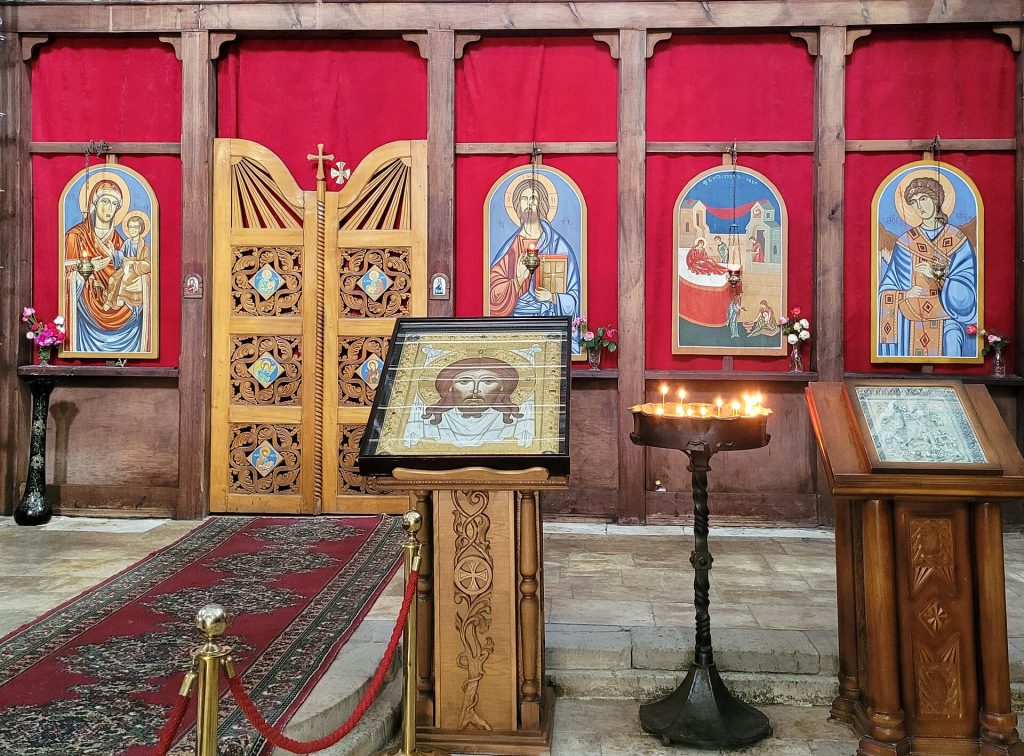
The central act of Mariamoba is the liturgy (Ghvtismsakhureba), held on the eve and morning of the feast in every church, but with particular solemnity at those dedicated to the Dormition or the Virgin. Worshippers bring baskets of grapes, apples, pears and homemade bread to be blessed by the priest, a practice tied to the late-August timing of the feast at the height of the fruit and early grape season in eastern Georgia. After church, families gather for a supra (feast table), where the toastmaster, or tamada, leads a sequence of toasts — sadγegrdzelo — that on this day always includes a toast to the Virgin and to every Mariam present.
Because it is a universal name day, Mariamoba carries a social warmth distinct from purely liturgical feasts: friends and relatives of anyone named Mariam, Maro, Mariko or Mariami are expected to call, visit or send congratulations, much as on an individual birthday. In Kakheti, where the feast coincides with final preparations for rtveli, the grape harvest, conversations at the table often turn to when picking will begin. In mountain communities such as Svaneti and parts of Khevsureti, villagers make pilgrimage on foot to shrines known locally as Mariamtsminda (“Holy Mary”), often walking considerable distances from scattered hamlets to a single ancient chapel. In Guria and Adjara, village fairs (bazroba) are sometimes held near Marian churches, combining the religious occasion with trade in produce and handicrafts.
When it happens
Mariamoba falls on a fixed date in the Georgian Orthodox Church’s calendar, which follows the Julian reckoning for its fixed feasts: 15 August Julian corresponds to 28 August on the civil Gregorian calendar used in daily life. In 2026 the feast fell on Friday, 28 August; the next observance is Saturday, 28 August 2027. It is a statutory non-working public holiday nationwide, meaning government offices, banks, courts and most schools are closed, and many private businesses reduce hours or close for the day, though restaurants, hotels and transport continue to operate.
Where to experience it
Sioni Cathedral in Tbilisi’s Old Town, formally the Dormition Cathedral, hosts the principal city service, usually beginning in the morning with an all-night vigil the evening before; the Catholicos-Patriarch frequently officiates here or at other major churches on the day itself. In Samtskhe-Javakheti, the rock-cut Dormition church at Vardzia, carved into the cliffs above the Mtkvari River under Queen Tamar, holds a quieter but atmospheric service amid its 12th-century frescoes. In Imereti, Gelati Monastery near Kutaisi, with its own Marian dedication, draws pilgrims and visitors to its UNESCO-listed complex (whc.unesco.org). Across Kakheti’s villages, smaller parish churches offer a more intimate view of the fruit-blessing custom.
Visitors are welcome at services but should dress modestly: long sleeves and covered shoulders for everyone, headscarves and skirts or long trousers for women, no shorts for men. Photography inside during the liturgy is best avoided or kept discreet; candles are lit silently, and conversation is kept low. If invited into a home for a Mariamoba supra, bringing a small gift — fruit, sweets or wine — is customary, and guests should expect to be drawn into the toasting.
Did you know
- Mariamoba is one of several Georgian “-oba” feast days, alongside Giorgoba and Barbaroba, that function simultaneously as a universal name day for everyone sharing the saint’s name.
- Because the Georgian Church uses the Julian calendar for fixed feasts, Mariamoba falls thirteen days after the Western Christian Assumption of 15 August.
- Georgian Christian tradition credits a woman, St. Nino, with the country’s 4th-century conversion, a fact often cited to explain the unusually strong Marian dedication of Georgian churches.
- The rock-cut Dormition church at Vardzia, consecrated in 1185 under Queen Tamar, preserves one of the more complete surviving cycles of 12th-century Georgian fresco painting.
- Late August, when Mariamoba falls, is also when eastern Georgian winemaking families begin timing the start of rtveli, the annual grape harvest.
Practical tips for visitors
Expect closed banks, government offices and many shops on the holiday itself; museums and major tourist sites generally remain open but may run reduced hours, so checking ahead for specific venues is advisable. Transport, including domestic flights, trains and marshrutka minibuses, runs on normal schedules. Late August in Tbilisi and Kakheti is hot, so visitors attending outdoor services or travelling to Vardzia should carry water and sun protection, as the cave complex offers little shade. Those wishing to join a village fruit-blessing or a family supra are best introduced through a local host or guide, since these are social rather than ticketed events; church services, by contrast, are open to all visitors who observe modest dress and quiet conduct.
Combine it with
Mariamoba pairs naturally with a late-summer visit to Kakheti, where the feast overlaps with the start of the grape harvest, or with Samtskhe-Javakheti for the Dormition church at Vardzia. A stop in Tbilisi allows visitors to attend the principal liturgy at Sioni Cathedral before travelling further into the regions.
Questions travellers ask
Is Mariamoba a public holiday in Georgia?
Yes, it is a nationwide, non-working public holiday observed every year on 28 August by the civil calendar.
What does the word “Mariamoba” literally mean?
It combines “Mariam,” the Georgian form of Mary, with the suffix “-oba,” which forms the name of a feast day, so it reads roughly as “the day of Mariam.”
Is Mariamoba the same as the Catholic Assumption of Mary?
They commemorate the same event, the end of the Virgin’s earthly life and her assumption into heaven, but fall on different civil dates because the Georgian Church uses the Julian calendar for fixed feasts, placing Mariamoba on 28 August rather than 15 August.
Do shops and museums close for Mariamoba?
Banks, government offices and many smaller shops close, while restaurants, hotels and major museums generally stay open, sometimes with shortened hours.
Can tourists attend the church services?
Yes, services are open to the public; visitors are welcome to observe or participate quietly as long as they follow modest dress and respectful conduct.
What should visitors wear to church on Mariamoba?
Covered shoulders and knees for everyone, with women generally wearing a headscarf and a skirt or long trousers, and men avoiding shorts.
Is there a specific festival or market to see?
Some villages, particularly in Guria and Adjara, hold small fairs near Marian churches on or around the feast, combining worship with local produce and craft trading, though these are informal rather than organised tourist events.
Does Mariamoba relate to the grape harvest?
Informally, yes: in Kakheti the feast falls just as families finalise plans for rtveli, the grape harvest, and the fruit-blessing tradition at church reinforces this seasonal link, though the feast itself is religious rather than agricultural in origin.
Sources
- Georgian Orthodox and Apostolic Church (Patriarchate)
- UNESCO World Heritage, Historical Monuments of Mtskheta
- UNESCO World Heritage, Gelati Monastery
- Georgian National Tourism Administration
- Ministry of Culture, Sport and Youth of Georgia
- 1. Law of Georgia on Public Holidays
- 4. Agenda.ge — Georgia celebrates Mariamoba public holiday
- 8. gov.ge — official public holidays calendar
- 10. National Parliamentary Library of Georgia — digitized Mariamoba liturgical texts
Plan your Georgia
Want to be in Georgia for Mariamoba? A GTour travel expert designs the itinerary around it and calls you back.
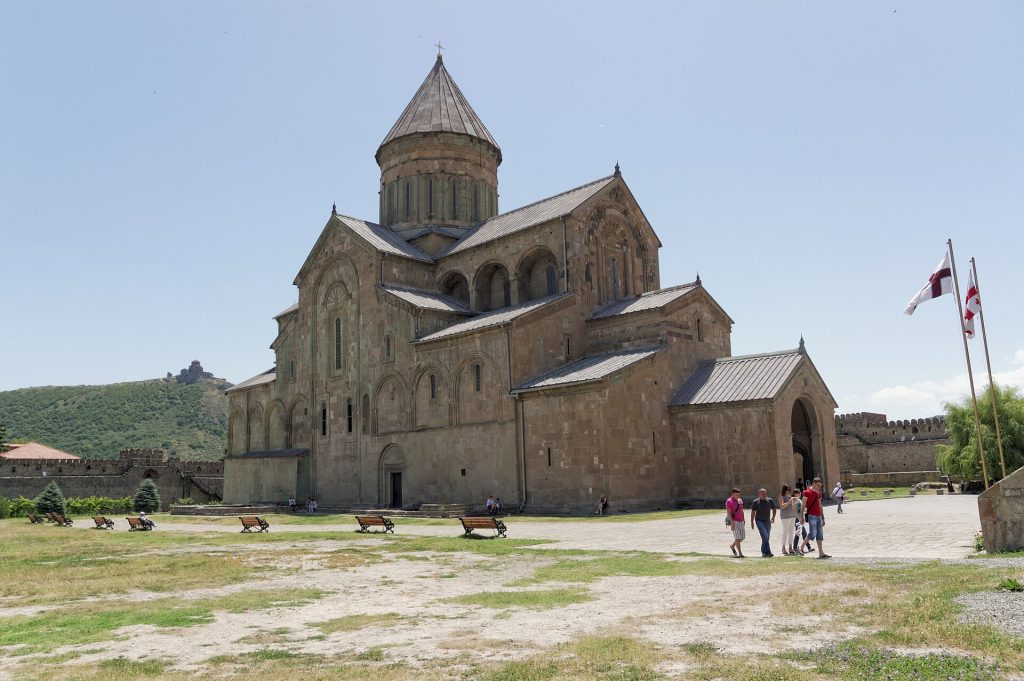
Svetitskhoveli Cathedral in Mtskheta, a major pilgrimage site for Mariamoba, the Dormition of the Virgin. · Photo: Bernard Gagnon / Wikimedia Commons, CC BY 4.0
This page in other languages: Русский
GTour conciergeAsk anything about Georgia · we reply within hours